SHOULD/SHOULDN´T HAVE
FUNCIÓN:
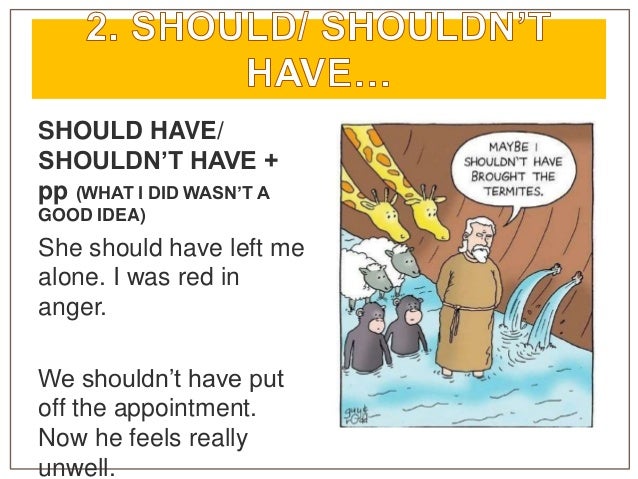
Nosotros usamos el modal perfecto should/shouldn´t have para criticar o expresar pesar por cosas que
la gente hizo o no hizo en el pasado.
FORMA:
Non-defining relative clauses:
|
|
Should have + past participle
|
I/he/she/we/you/they should have gone to the doctor.
|
gShouldn´t have + past participle
|
I/he/she/we/you/they shouldn´t have been rude to the
store assistant.
|
¡CUIDADO!
What did Pierre do
wrong?
x He shouldn´t hit the other guy.
ü He shouldn´t have hit the other guy.
|
1.- SHOULD HAVE + PAST PARTICIPLE
FUNCIÓN:
Puede significar algo que hubiera sido una buena idea,
pero que no lo hiciste. Es como dar consejos sobre el pasado cuando se lo dices
a otra persona, o lamentando lo que hiciste o no hiciste cuando estás hablando
de ti.
EJEMPLOS:
She should have taken
the children with her to Houston. (Ella
debería haber llevado a los niños con ella a Houston)
He should have lent
us the money which we need. (Él
debería habernos prestado el dinero que necesitamos)
She should have been
back by noon. (Ella debería haber
regresado para mediodía)
She should have
returned later. (Ella
debería haber regresado más tarde)
You should have
learnt at least five new words every day. (Tú deberías haber aprendido al menos cinco palabras cada
día)
2.- SHOULDN'T HAVE + PAST PARTICIPLE
FUNCIÓN:
Podemos usar 'should not have' para especular
negativamente sobre lo que puede haber ocurrido o no.
También podemos usar 'should not have' para arrepentirnos
de acciones pasadas.
Significa que algo no fue una buena idea, pero lo hiciste
de todos modos.
EJEMPLOS:
You should not
go by plane. (Tú no deberías ir en
avión)
He should not save
some money each week. (Él no debería
ahorrar algo de dinero cada semana)
He should not pay
more attention to what the teacher says. (Él
no debería poner más atención a lo que dice el maestro)
It should not
rain this evening. (No debería llover
esta tarde)
We should not ask
permission before doing it. (Nosotros
no deberíamos pedir permiso antes de hacerlo).
EJERCICIOS:
Complete the
sentences with should have or shouldn´t have and the correct form of
the verb in parentheses.
1. Maddie _______________ (call) the police as soon
as the boys vandalizing the club.
2. I _______________ (drive) 50 km/h instead
of 65 km/h in the city. Then I wouldn´t have
gotten a speeding ticket.
3. You _______________
(lie) to the police about spraying graffiti. They
know you did it.
4.
Dad _______________
(park) illegaly on the sidewalk.
5.
James _______________
(download) those music files. It´s
wrong and the sound quality was terrible!
6. We _______________
(tell) a security guard that we saw those girls shoplifting.
7. Beth ______________
(litter) while she was driving. A
police officer saw her throw out a bag and a cup and she was fined.
8.
I know you were in a hurry, but you _______________
(evade) the train fare.
WAS/WERE GOING TO AND WAS/WERE SUPPOSED TO
FUNCIÓN:
We use going to in
the past to talk about plans and intentions that didn´t happen.
We use supposed to in
the past to talk about things we were expected to do but didn´t do.
Non-defining relative clauses:
|
|
Was/were going to +
base form
|
I was going to call you. We weren´t going to come
but we changed our minds.
|
Was/were supposed to
+ base form
|
You were supposed to copy Vallerie in on all the
mails.
|
¡CUIDADO!
x I was to go
shopping, but it started raining.
1. I was going to
go shopping, but it started raining.
|
1.-
Was/ were going to + base form:
Se
forma con el verbo 'to be' en pasado, seguido de 'going to' y luego el verbo
principal
AFIRMATIVA: Para formar la afirmativa ponemos la forma
correspondiente del verbo 'to be' acompañado de 'going to' y un verbo.
Sujeto + was/were + going to + verbo + resto de frase.
Ellas iban a bailar en una fiesta.
They were going to dance in a
party.
EJEMPLOS:
I was going to see you tomorrow. (Yo iba a verte mañana)
He was going to visit her next week. (Él la iba a visitar la siguiente semana)
They were going to eat out tonight. (Ellos iban a comer fuera esta noche)
She was going to leave for Europe on Monday. (Ella iba a partir a Europa el lunes)
She was going to wait me after the show. (Ella iba a esperarme después del
espectáculo)
2.-
Was/ were supposed to + base form:
Usaremos
was/were supposed to para hablar sobre cosas que nos pusimos de acuerdo para
hacer, o que la gente espera que hagamos, pero que no hicimos.

EJEMPLOS:
1. He is supposed to take his dance lesson at seven o’clock.
(Se supone que él toma su clase de baile a las siete en punto)
2. They were supposed to bring the books with them. (Se
supone que ellos traen los libros con ellos)
3. He is supposed to arrive tomorrow. (Se supone que él
llega mañana)
4. You are supposed to be here after four o’clock. (Se
supone que tú estás aquí después de las cuatro en punto)
5. We are supposed to send them a letter. (Se supone que
nosotros les enviamos una carta).
EJERCICIOS:
Reescribe las oraciones usando la palabra entre
paréntesis.
1. We planned to leave
at nine, but we didn´t. (supposed)
_______________
2. Shawn wanted to have a party, but he was sick. (going)
_______________
3. I wasn´t sure about going to party, but I did. (going)
__________________
4. I wanted to go shopping yesterday, but I got out of
work late. (supposed) _
5.They intended to move
to the U.S.A, but they didn´t. (going)
____________
6. You shouldn´t
have told Julia about the surprise. (supposed) __________
7.The weather forecast said it would rain today. (going)
_________________
Completa las oraciones con was / were going to / was /
were supposed to
I was standing in
line and I _____________ buy the
Inception DVD, but I decided to put it down because I needed to save money.
I don't ______________________ you could lend
me some money, could you?
I am not ________________________
smoke here. This is a place for children.
_____________________________ you won the lottery,
what would you buy?
I _______________________ it will snow. Don't go out without a warm jacket.