lunes, 16 de abril de 2018

defining and non-defining relative clauses


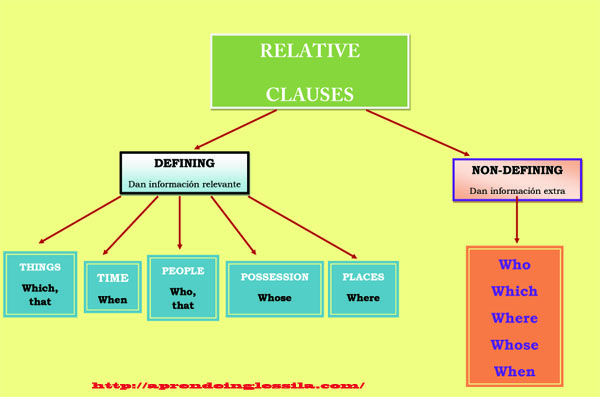
NON-DEFINING RELATIVE CLAUSES

Resultado de imagen para non defining relative clauses examples
FUNCIÓN:
Una cláusula relativa no definitoria nos da información adicional sobre un sustantivo.
La cláusula relativa podría eliminarse de la oración sin afectar el significado básico.
A veces se puede usar para referirse a lugares.
Las "non-defining relative clauses" están compuestas por un pronombre relativo, un verbo y otros elementos opcionales, como el sujeto o el objeto del verbo. Siempre se emplean comas o paréntesis para delimitar las oraciones de relativo no especificativas y separarlas del resto de la oración principal.

FORMA:
Non-defining relative clauses:

·      Están separados del resto de la oración por comas.
·      Solo puede venir después del sustantivo al que se refieren.
The Charleston museum, which is the oldest museum in the U.S., was built in 1773.
·      Solo se puede usar a quién hace referencia a las personas, y a qué se refieren los lugares y las cosas.
·      A veces se puede usar para referirse a lugares.
Daniel Radcliffe, who played Harry Potter, now acts in the theater. The college, which specializes in languages, is near New York City. Seattle, where my parents live, is a very beautiful place.


PERSONA
COSA
LUGAR
Sujeto
Who
Which
-
Objeto
Who
Which
Where
Posesión
Whose
-
-

Resultado de imagen para non defining relative clauses examples

¡CUIDADO!
          x   Tchaikovsky, he wrote Swan Lake, was born in 1840.
 ü     Tchaikovsky, who wrote Swan Lake, was born in 1840.
x   This car, that we bought last year, is from Italy.
ü  This car, which we bought last year, is from Italy.

EJEMPLOS:
John's mother, who lives in Scotland, has 6 grandchildren.
My friend John, who went to the same school as me, has just written a best-selling novel.
My grandmother, who is dead now, came from the North of England.
We stopped at the museum, which we had never visited before.
I've just come back from London, where John lives.
Yesterday I met a woman named Susan, whose husband works in London.

EJERCICIOS:
Escribe oraciones con cláusulas de relativo no definidas, usando la información dada.
1. - The Paris Opera Ballet is the oldest ballet company in the world. It was founded in 1669.
The Paris Opera Ballet, which was founded in 1669, is the oldest ballet company in the world.
2. – Harry Houdini was born in 1874 in Budapest. He was a famous magician.
______________________________________________________________
3. – Swan Lake was based on Russian folktales. It was written by Tchaikovsky.
______________________________________________________________
4. – The Sydney Opera House was designed by Jorn Utzon. It opened in 1973.
______________________________________________________________
5. - The first opera was called Dafne. It was performed in 1598.
______________________________________________________________

DEFINING RELATIVE CLAUSES


FUNCIÓN:
Las cláusulas relativas definitorias nos dan información adicional sobre un sustantivo. No se puede eliminar de la oración sin afectar el significado básico.
Como su propio nombre indica, las "defining relative clauses" ofrecen información esencial para definir o identificar a la persona o cosa de la que estamos hablando.
Las "defining relative clauses" están compuestas por un pronombre relativo (que a veces se omite), un verbo y otros elementos opcionales, como el sujeto o el objeto del verbo. No se utilizan comas para separar la proposición relativa especificativa del resto de la oración. Las comas o los paréntesis se emplean para delimitar otro tipo de oraciones de relativo, las explicativas o "non-defining relative clauses".

EJEMPLOS:
·         Children who hate chocolate are uncommon.
·         They live in a house whose roof is full of holes.
·         An elephant is an animal that lives in hot countries.
·         Let's go to a country where the sun always shines.
·         The reason why I came here today is not important.

  FORMA:
Defining relative clauses:

No necesita comas para separarlos del resto de la oración.
The movie which/that we saw last week was directed by Martin Scorsese.
The director who/that won the award not at the ceremony.
We stayed in the place where we had our honeymoon.
Va detrás del nombre al que se refieren.
Puede usar which/that para referisrse a cosas.
Puede usar who/that to para referirse a personas.
Puede usar where para referirse a lugares.
Subject and object relative clauses
Un sustantivo puede ser el sujeto o el objeto de una cláusula relativa definitoria.
The actress who wore the exquisite at the end of the movie is a model. (subject)
Cuando el sustantivo es el objeto de la cláusula relativa, el pronombre relativo puede omitirse.
The dress (that/which) the actress wore at the end of the movie is exquisite. (object)


PERSONA
COSA
LUGAR
TIEMPO
MOTIVO
Sujeto
Who/That
Which/That
-


Objeto
Who/That
Which/That
Where
When
Why
Posesión
Whose
Whose
-


EJERCICIOS:

Lee las oraciones. Subraye la cláusula relativa definitoria y coloque una X al lado de las oraciones donde se puede dejar el pronombre relativo.
1. - The song which plays at the end of the movie has been a big hit this summer.


2. – Look! He´s the actor who I was telling you about.

3. - The company that sold me the car has gone bankrupt.

4. - The Australian dancer who got the part is unknown in her home country.
5. - I recognized the famous landmarks which the director used in several scenes.

6. - Do you remember the woman who promised to invite us to the party?


martes, 27 de marzo de 2018

INFINITIVE CLAUSES WITH IMPERSONAL IT AND WISH AND IF ONLY FOR REGRETS

INFINITIVE CLAUSES WITH IMPERSONAL IT

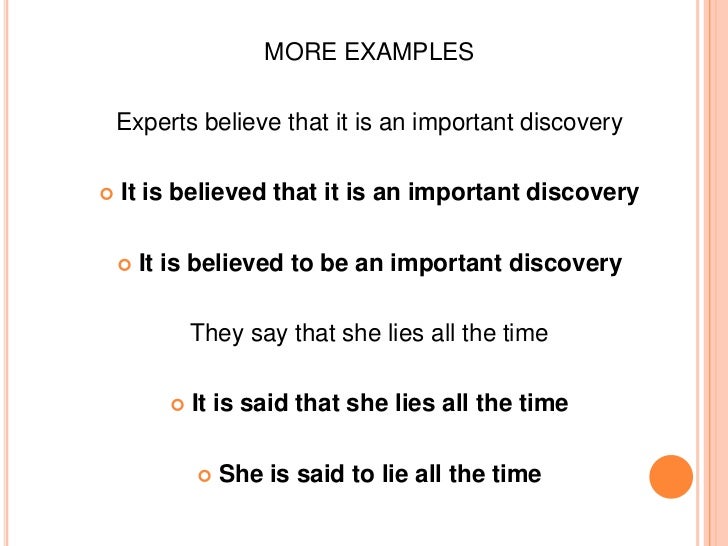
Resultado de imagen para IMPERSONAL IT
FUNCIÓN:
Usamos la cláusula is (not) + adjetivo + infinitivo cuando queremos usar el adjetivo para describir una acción o situación. Esto significa lo mismo que usar el gerundio como sujeto.
FORMA:
It´s (not)
Adjetivo
Clausula infinitiva
It´s
Important
Good
Better
Essential
To eat poperly
To get in shape
To speak to a professional
To get some slee

¡CUIDADO!
 X   It´s important to rest.
 ü  Is important to rest.
 X   It´s better to go to the hospital.  
 ü  It´s better go to the hospital.  

EJERCICIO :
Match the problems 1-6 with the solutions a-f.
1 I haven´t gotten any interviews get.
2 I´ve been putting on a lot of weight recently.
3 I´m not sure what I want to study.
4 What skills do I need to be an engineer?.
5 Ouch! I have a small cut.
6 I pulled a muscle this morning.
a It´s better not to move it too much.
b It´s not good to drive so much. Try to walk more!
c It´s important to consider what career you want later.
d It´s better to put a bandage on it.
e It´s essential to have a degree in math.
f It´s difficult to get a job right now, but don´t give up!
               
                Resultado de imagen para IMPERSONAL IT                                                           


WISH AND IF ONLY FOR REGRETS
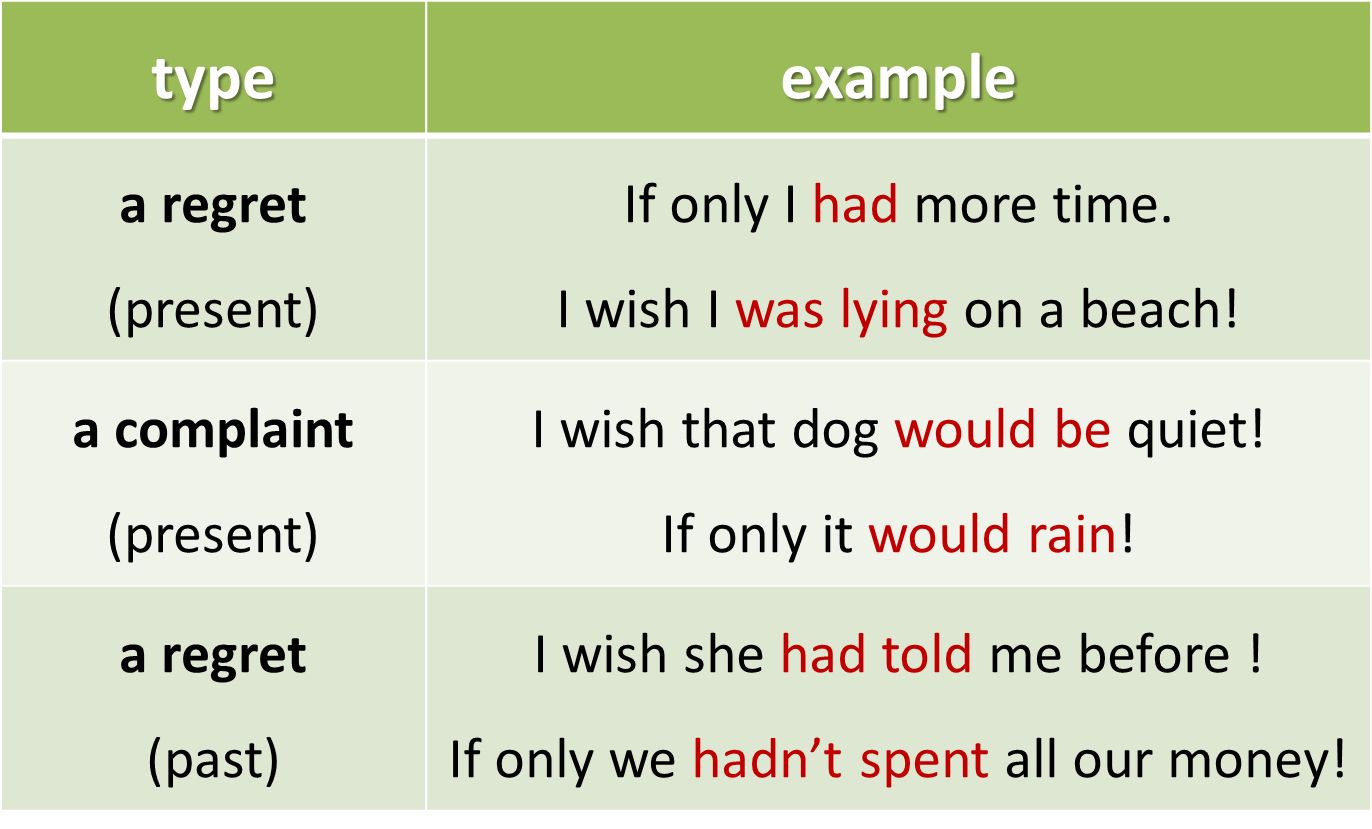
Resultado de imagen para WISH AND IF ONLY FOR REGRETS
FUNCIÓN:
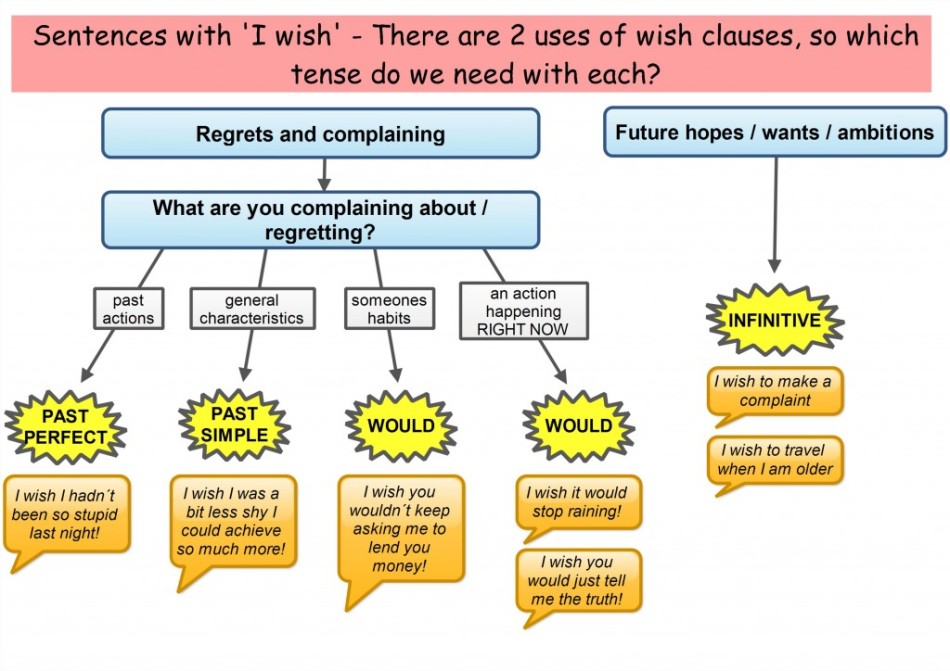
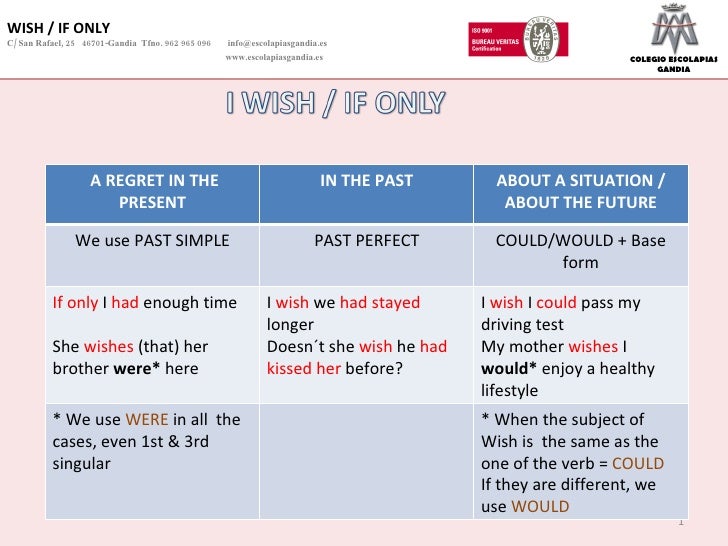
Nosotros usamos wish/if only + paado perfecto to talk about things we would like to change about the past.
      
 
Subject + wish + past perfect
·      I wish I had learned to play a musical instrument when I was younger.
·      I wish I had been more adventurous.
·      I definitely wish I hadn´t smoked.
If only + subject + past perfect
·      If only I had changed careers years ago.

Hablando en pasado: 
Si se quiere expresar un arrepentimiento por algo que se hizo o que no se llegoi hacer se usa la sieguiente estuctura: Wish/if only + past perfect.
Ejemplo: I wish/If only I hadn´t been so rude to my mother last night.

Hablando del presente:
Cosas que no se han hecho realidad en el presente y cosas que pueden hacerse realidad en el futuro y se usa la siguiente estructura: Wisch/If only + past simple.
Ejemplo: I wich I were in the Caribbean instead of being here.

Presente y futuro:
Cambiar el estado de las cosas del presente o futuro: I wich I had motorbike.
  • Para expresar un deseo sobre algo que sucederá en el futuro en un tono formal y cortés:
    "I wish to attend the meeting."
  • Para desear algo a otra persona para el futuro, por lo general en ciertas expresiones tales como:
    "I wish him the best of luck." = le deseo la mejor de las suertes.
 "wish" / "if only" 
Se puede usar "wish" y "if only" para expresar un deseo poco probable o imposible o una queja:
Con el pasado simple para expresar un deseo imposible en la actualidad:
  • "I wish I lived in the countryside."
  • "If only I lived in the countryside." = ojalá viviera en el campo
    No vivo en el presente en el campo por lo que este deseo es ahora mismo imposible.
Con el pasado perfecto expresa un arrepentimiento por algo sucedido en el pasado:
·         "I wish I hadn't eaten the prawns."
·         "If only I hadn't eaten the prawns."
Ojalá no hubiera comido aquellas gambas: me arrepiento de haber comido aquellas gambas en el pasado.

Con would/could para expresar un deseo que creemos que es poco probable o imposible en el presente:
  • "I wish he would save money."
  • "I wish he could save money."
  • "If only he would save money."
  • "If only he could save money."
    pero no "I wish he will/can save money."
    no creo que pueda / vaya a ahorrar dinero, así que esto es un deseo imposible dada su nula habilidad en el presente para ahorrar dinero
¡CUIDADO!
 X   I wish I hadn´t broken my leg when I was a teenager.
 ü  I wish I didn´t break my leg when I was a teenager.
 X   If only I hadn’t left my job.
 ü  If only I haven´t left my job.

EJERCICIO
Complete la segunda oración usando la palabra entre paréntesis para que signifique lo mismo que la primera.


    1.    My doctor gave me good advice. I didn´t listen.
__________________________________________
    2.    Terri wanted to go to college, but she didn´t go.
__________________________________________
    3.    I ate a huge breakfast this morning. Now I feel sick.
__________________________________________
    4.    James stayed up late last night. This morning, he´s really tired.
__________________________________________________
    5.    I didn´t work hard in school. I failed my exams.
_______________________________________
    6.    My parents drove to Florida. The trip was terrible. 

_______________________________________                                                                                    
              wish-clauses-simple-web-page-001-1024x724
                       Resultado de imagen para WISH AND IF ONLY FOR REGRETS

domingo, 25 de febrero de 2018

Relative clauses and gerund/infinitive

RELATIVE CLAUSES

FUNCIÓN:
Usamos “relative clauses” para dar más información sobre una persona, cosa, tiempo o lugar.

Relative clauses
Significado
           Información
Who
Quien
Personas
Where
Donde
Lugares
When
Cuando
Momentos/Tiempo
Which/That
Cual/Que
Cosas y/o objetos

                Resultado de imagen para RELATIVE CLAUSES
FORMA:

Relative clauses
Ejemplos
Who
I thanked the person who found my wallet this morning on the subway.
Where
The best time to call him is when the finishes his meeting at 10:30 a.m.
When
The Blue Lounge was place where I used to meet my friends.
Which/That
I think it was a trip to Paris that made me want to learn French.

CUIDADO!
x   The report that it has all the information is on your desk.
 ü  The report that has all the information is on your desk.
 x   The man which donated a lot of money is a billionaire.
 ü  The man who donated a lot of money is a billionaire.

Nota 1: El pronombre relativo que se usa en lugar del pronombre posesivo. Debe ser seguido por un sustantivo. Ejemplo: There's a boy in grade 8 whose father is a professional tennis player.
Nota 2: Los pronombres relativos donde y cuando se usan con nombres de lugar y tiempo. Ejemplos: FIS is a school where children from more than 50 countries are educated. 2001 was the year when terrorists attacked the Twin Towers in New York.

Una proposición relativa no definitoria o explicativa, nos da más información sobre la persona o cosa de que se trate. Si eliminamos una proposición explicativa perdemos algunos datos pero el significado general de la oración principal sigue siendo el mismo. Las proposiciones subordinadas explicativas siempre se delimitan con comas o paréntesis.

EJEMPLOS
  • The farmer, whose name was Fred, sold us 10 pounds of potatoes.
  • Elephants, which are the largest land mammals, live in herds of 10 or more adults.
  • The author, who graduated from the same university I did, gave a wonderful presentation.
  • My mother, who is 86, lives in Paris.

EJERCICIOS:
Completa las siguientes oraciones con: which/that, who, when o where.
    1. A web designer is a person _____ can make your website look more professional.
    2. It´s a technique ______ helps you learn more effectively.
    3. A good time to do brain training is _____ you feel relaxed.
    4. It was my brother ______ used to take us swimming every Sunday.
    5. We got married at place _____ we first met.
    6. I´m going to choose a course _____ I´m really interested in.

SENSE, SENSITIVE AND SENSIBLE

SENSE, SENSITIVE AND SENSIBLE               FUNCIÓN Sense Cualquiera de las facultades, como la vista, el oíd...